Thursday, 31 October 2013 in , ,

Annihilation Prologue

Annihilation: Prologue (2006) one-shot
Prologue is a fast-paced opening to the cosmic event. We know it's a Marvel Cosmic (with a capital C) event when Thanos appears on the first page and within the next few pages the Kyln maximum security prison and power station is destroyed as the first of the Annihilation Wave come through through the interstellar energy cascade nearby.

Quickly introduced are Richard Rider and the Nova Corps, Drax and Cammi (remember the little girl from Alaska?), Ronan the Accuser (Kree), Silver Surfer and Super-Skrull (though he's not named in the issue). The home planet of the Nova Corps, Xandar, is realised excellently with the immense size and power of the Corps shown off. Very quickly Xandar is attacked and devastated. The pages where the Annihilation Wave suddenly appears and the Corps overwhelmed are epic. We're shown glimpses of the Kree and Skrulls before the reveal of who is masterminding the Annihilation Wave... Annihilus, the insectoid ruler of the Negative Zone.

It's a great single issue and sets up the event incredibly dramatically. I much prefer Keith Giffen's scripting here on a cosmic scale than the close-up Drax mini-series. The art is great by Scott Kolins and Ariel Olevetti (some dynamic panelling though there are some awful computer-generated blurs that really detract from the visual storytelling) and there's definitely a nod to Moebius in the spaceship and alien city designs. I really like the time-stamping at the start of each scene so we get to know the timespan of events: it starts the day before the invasion (which is called Annihilation Day) and the Prologue ends 16 days later. I'm guessing that "day" would be some sort of inter-galactic day rather than earth day. Also, at the end of the single-issue of Prologue are some great extras: information about the Corps, Annihilus, Thanos plus a glossary and map. By the end of reading this there's a great sense that the event has been realised in great detail.
The big reveal... Annihilus is behind the Annihilation Wave.


Wednesday, 30 October 2013 in , , ,

Before Annihilation: Drax the Destroyer miniseries (2005)

Drax issue 1 (2005)

Drax the Destroyer #1-4

This miniseries precedes the Annihilation event by a few months. In the fourth issue there's an editorial in which readers are told that the comic "is just the tip of the iceberg. What we've really done is give you a glimpse or a preview of what is to come".

More or less this is a re-boot, or at the very least another "resurrection", of the Drax the Destroyer character. The story, by Keith Giffen, is fine but Mitch Breitweiser's art - helped enormously by Brian Reber's colouring - is great: he draws figures in epic poses against expansive skylines beautifully.

Drax is on board a spaceship heading for Kyln, a maximum security prison. The other prisoners include Paibok the Skrull, the Blood Brothers and a pretty menacing villain called Lunatik. The spacecraft crashes near Coot's Bluff in Alaska. The Drax who survives the crash is large and brutish: very Hulk-like and, over the course of the four issues, transforms into the Drax that Marvel seem to be using now. Much of what happens involves the Blood Brothers and Lunatik fighting with Drax, while the crafty Paibok enslaves the townsfolk of Coot's Bluff and forces them to work on repairing the damaged spaceship. Drax is befriended by a small girl called Cammi who is fascinated by the aliens she sees. At the end of the second issue Drax is stabbed through the head by Paibok and apparently killed. What seems to happen is that Drax starts to "cook" and out of the baked body, a smaller Drax climbs - with the distinctive red markings on his shoulders. When Cammi asks him why he changed Drax explains: "I am restored. Once again the Destroyer."


He finds that he has lost some of his powers - like power blasts - but he has gained a greater perception: there's a great sequence where Drax walks across a mountainside in the rain and is exhilarated by the experience. The Blood Brothers, who have a Wolverinish scent ability, claim that they smell Cammi when they find Drax. The two have "bonded" in some way. At the end Paibok sends a distress call and a second prison ship picks Drax and Cammi up.

There's not a great deal of Annihilation in this series. It's more of a prologue to the Prologue. Presumably the purpose was to rebirth Drax and give him a child to defend against the Annihilation Wave.


Monday, 28 October 2013 in , , ,

Before Infinity there was Annihilation


Marvel's current event, Infinity, has the Avengers deep in space fighting the Builders - who seem to be the original architects of the universe - while the mad Titan, Thanos, attacks a seemingly defenceless Earth. There's a lot more to this event as it appears to involve the fall-out from Age of Utron, Uncanny Avengers and New Avengers. For a lot of casual readers Infinity is too rich, too complex and involves far too many characters. It requires a good deal of concentration and - like many of Hickman's titles - the payoff may be a little time coming. It has an incredibly fast pace and draws on long-running cosmic history that goes right back to the early 1970s.

It's not the first time that Marvel has involved its universe in an all-out cosmic war. Perhaps the first one was the Kree-Skrull War in the pages of The Avengers in 1971-2. In the 1990s the various Infinity  conflicts involving Thanos and Adam Warlock plunged regular Marvel heroes into vast intergalactic events.

The big question for me, someone who wasn't reading Marvel at that time, is whether the 2006 Annihilation storyline and its 2007 sequel are connected to what's currently happening in the Marvel Universe. Over the next few weeks I'm going to discuss the various titles that constituted Annihilation and ask the question: does it stand up today as a decent comic series worth reading?


Wednesday, 12 June 2013 in ,

Man of Steel Countdown - For Tomorrow (2004)


For Tomorrow (2004, FROM SUPERMAN #204-215)

I certainly remember this as being better the first time I read it. Perhaps I was (and still am) wowed by Lee and Williams' art - which, for me, is how I envisage a modern Superman looking. Brian Azzarello's story, however, is a real clunker. I'm not sure why this was called "For Tomorrow". Was it an attempt to suggest that this version of Superman is how the creators saw him developing? Is it that it's about Kal-El's concerns about how he wakes up to the prospect of being Superman every day and how he manages to remain optimistic and up-beat?

The premise - in which a million people across the Earth including Lois Lane disappeared mysteriously a year earlier - is great. The problem is that the execution of the story is agonisingly convoluted and, ultimately, becomes pretty boring. What is central is a highly contrived narrative about Superman modifying a Phantom Zone projector to send people to a paradise and then mind-wiping himself so he fails to know where all the millions of people have gone. There's also various sub-plots, including involving a villainous OMAC prototype called Equus, who actually looks like a 1990s Wildstorm character.


Incredibly introspective and broody, it has the feeling that a four-issue story is stretched out beyond all proportions with lots of odd elements added that make it an unsatisfying read. Azzerello creates a morally ambiguous world for Superman to inhabit. All the way through it's impossible to know who the bad guys are because the good guys aren't really much better. Equally, some of the dialogue is pretty awful (there's one sequence between Batman and Superman that made me feel awkward - almost like reading a Hollywood scriptwriter's attempt who just doesn't "get" the idea of DC Universe).

Like I said, I remember this being better when I read it about 5 years ago but I think that the single thing that really doesn't work here is the character of Superman. He's far too introspective and angst-ridden (ok, I realise he's literally lost his wife and, somehow, he's responsible but he lacks the dogged, boy scout-ness that makes Superman Superman). The first half of the story has a pretty passive Superman who spends his time visiting a priest (although he does go into space to save Green Lantern - who, uncharacteristically, seems to shout "Save me!").

Much of the narrative is actually heavy-handed moral dilemmas: Superman musing about his role in the world, warfare, a priest dying of cancer and so on... To me they feel artificially forced and out of keeping with the sort of thing a Superman comic should be. I can see how DC could look at a comic like this and think it was time for a re-boot. It is, however, Jim Lee's art that I think is stunning. Whenever he draws members of the Justice League they look epic. Here, we get Batman and Wonder Woman in particular looking awesome.

I'm hoping that this "darker" angst-ridden Superman isn't the character we get in the Man of Steel movie. Personally, I don't think we need an intense, Batman-type personality. Or an intense, autistic character concerned about his discomforting alien-ness. Or an average joe who reflects on his desire to be ordinary when putting on the cape. I'm hoping he's the "Big Blue", the up-beat, inspirational symbol who saves the day because he is a super man. When Superman gets complicated we end up with a story like For Tomorrow.

Tuesday, 11 June 2013 in ,

Man of Steel Countdown - The Man of Steel (1986)

For many, John Byrne's 1986 mini-series, The Man of Steel, marked the first of the post-Silver Age Superman comics. Marv Wolfman had wanted a re-boot of the Superman story for a while and, when Byrne had left Marvel, the opportunity for a high-profile re-launch took place. It's difficult now to imagine how divisive this was at the time - the New 52 Superman hasn't caused nearly as much upset as Byrne's (perhaps fans have just become more tolerant over recent years). The series was bi-monthly and - Byrne is phenomenally quick in drawing (checking his Comic Book Database entry suggests he could easily draw three or four comics a month - all to an incredibly high standard). The comics aren't an arc: they're more standalone snapshots in the early years of Superman - from his decision to be Superman through meeting Lois, Batman, Bizarro and Luthor to a final issue where he is confronted with the personal effect leaving Smallville had. 
Looking back on this nearly thirty years later, it's difficult to see what all the fuss was about. Byrne's art is - typically - amazing and still looks very contemporary. There's no New 52-type redesign of any aspect of the costume and only some minor alterations to the elements of the narrative. I actually found the stories a little too pedestrian and predictable and the absence of a major villain like Darkseid or Braniac is noticeable. 


#1 - From Out of the Green Dawn


Issue one is the origin story. It seems to draw on the 1978 movie a great deal. The prologue is Jor-El and Lara sending Kal-El to Earth. I like the designs of the Kryptonian costumes and that Kal-El is grown in, effectively, a test tube. There's no Superboy in this continuity, rather Clark is a star footballer but Pa Kent (who doesn't die) reveals he's an adopted alien. Clark is involved in a major super-deed by saving a space plane with Lois on board (dramatically portrayed in the Superman Returns movie). The Kents make Clark his costume and the final panel has Clark assuming his Superman identity.

#2 - The Story of the Century

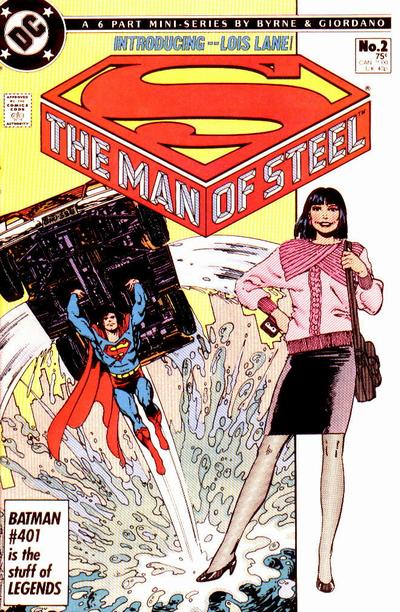
Next, the supporting cast are introduced. Lois Lane spends the issue chasing after Superman in order to get an interview. Clark Kent gets a job at the Daily Planet (on the basis of interviewing himself as Superman). The portrayal of Lois is straight from the movie - she even looks very much like a more elegant Margot Kidder. The rivalry between Clark and Lois is established in this issue.


#3 - One Night in Gotham City...

Superman and Batman get their first team-up and it's great: Superman tries to citizen arrest Batman at the start and, even after working together, is pretty wary of the dark knight. Batman is prepared: he warns that if Superman touches him he'll set off a bomb that would kill an innocent - it ultimately turns out to be himself. What lets this down is that the villain is a pretty lame Magpie, who - although does some pretty violent stuff - isn't enough of a challenge.


#4 - Enemy Mine...

Eighteen months later (yes, the story jumps down the timeline quickly), Lex Luthor is introduced and the origin of the Luthor/Superman feud is presented (basically it's because Superman won't go on Luthor's payroll). I like this Lex: he's a balding, ginger-haired villain that is a nod to the original Luthor in 1940. Basically, Superman fights a lot of terrorists on a boat.


#5 - The Mirror, Crack'd

The penultimate issue introduces (and kills) Bizarro who, here, is Lex Luthor's failed clone of Superman. There's an odd sub-plot of Lois Lane's blind sister who tries to commit suicide and is saved by Bizarro who then appears to give up his life so that she can regain her sight.


#6 - The Haunting

The final issue of the series has Superman return to Smallville where a computer program in his rocket informs him of his Kryptonian origins (it's the first point he realises he's an alien). There's a more engaging sub-plot where Clark is confronted by former girlfriend, Lana Lang, who reveals how damaging it was when he revealed his powers to her and left her behind.

Monday, 10 June 2013 in ,

Man of Steel Countdown - THE SHOWDOWN BETWEEN SUPERMAN AND LUTHOR


THE SHOWDOWN BETWEEN SUPERMAN AND LUTHOR (1963, FROM SUPERMAN #164 REPRINTED INSHOWCASE PRESENTS SUPERMANVOL. 4)

Today's re-read is a single 1963 issue of Superman. There are a number of Silver Age stories of the Man of Steel that I love - particularly those involving the variously crazy effects of Superman. They tend to be very weird indeed but often have plots that don't really stand up. It's a short 17 story written by the science fiction author, Edmond Hamilton with art by Curt Swan and George Klein. It's a classic story where the roles of hero and villain become reversed and Luthor shows himself to have a sense of humanity and sacrifices the possibility of defeating Superman in order to save the population of a desert planet.

Superman worries about people losing faith in him
Essentially, this is a Lex Luthor story. He challenges Superman to a fight on a world - "man-to-man" - where Superman's powers would be removed. Clark Kent decides to accept the challenge, believing that people would lose faith in him if he didn't. It's all very gentlemanly: Luthor and Superman meet to agree terms, take a rocket to a desert world and strip off to engage in bare-knuckled boxing. In the fight, Superman takes a black eye but decks Luthor who then disappears leaving Superman to cope with a fast-growing cacti forest. Superman has flashbacks to life on Krypton and gets disoriented in a sandstorm.

Luthor discovers a city under attack by giant birds and acts to save the city's population. The people see Luthor then as their saviour and convince him to help them search for water (they are on the brink of extinction). They see Superman as the villain and Luthor - in a role reversal - ensures that Superman is treated fairly.

Superman and Luthor strip down and grapple with each other
The portrayal of Luthor by Hamilton is far more nuanced than we come to expect from this period. He's no moustache-twisting flat character, instead he's more a proud scientist who simply wants to receive recognition for helping people. Luthor's villainy is shown as a product of being in Superman's shadow. Throughout, we read Luthor's thoughts in speech bubbles where he tries to convince himself that he's simply acting to win over the people of the desert planet in order to defeat Superman. The duel continues with Luthor using the ancient forgotten technology of the planet - an anti-gravity tornado and an automaton bloodhound - until Luthor actually fakes his defeat in order for Superman to travel to an ice planet in order to send water to the desert planet. When Superman calls Luthor out about taking the fall, Luthor denies it - but thinks: "He huessed my motive in losing the duel... but I'll never admit to him I went soft!" (Interestingly, there's a panel where Superman is shown to behave churlishly when he tells Luthor he would help the desert people "...even if they did think me a villain.").

A confused Superman thinks he's home
Superman appears in this far less one-dimensional than he appears in a lot of Silver Age adventures. He almost seems neurotic in much of the narrative: acutely worried what others think of him, pretty useless at fighting, completely disoriented for much of the time, pre-occupied with his loss of his home planet and distressed when he is considered the villain. I'll skip over the homoerotic overtones of the topless fight with Luthor. It's interesting to consider what sort of character Kal-El/Clark Kent would be long term without his powers. Certainly, he's pretty smug when he's invulnerable.

Even though this could be seen as a slight Superman story, it has all the elements of a classic tale: the rivalry with Luthor, the trope of a weakened hero, space action plus the presence of Krypton hanging over Superman's life.

Luthor can't open up to Superman
The artwork retains the fifties, George Reeves, physical depiction of Superman. To me he looks like he's a broad, well-built man about 45. He looks like a beefy John Hamm here. Panelling and artwork - which I do like a great deal - is conventional and really of the period. There's no sense yet of anything edgy or weird.

Saturday, 8 June 2013 in , , ,

Man of Steel - Countdown

Friday 14th June is the opening of the new Superman movie, Man of Steel, directed by Zack Synder. I've already booked my ticket for an opening day performance and I'm pretty hyped about seeing it. I've always been a fan of Superman right back to my childhood: I can remember going to see the epic Richard Donner Superman the Movie in 1978 and watching the old George Reeves tv episodes on Saturday mornings. It may be that Superman the Movie was responsible for my life-long love of comic books. Certainly, it was randomly picking up the hardback version of Brainiac by Geoff Johns and Gary Frank in 2009 that got me back into reading comics in a big way. Plus I love Synder's films for their powerful visual sense.

So, to get myself ready for the movie, I'm going to revisit my favourite Superman stories and blog about them every day up until next Friday. I've had to be selective - as there are tons of Superman stories and issues I could re-read this week. Quite often, the best Superman stories for me have been collaborations between tremendously engaging writers and amazing artwork - for its success a Superman adventure needs to look good and read good (other heroes - like Batman can seem to get away with not requiring both). I also suspect that if the story of the Man of Steel isn't up to the quality of the cinematography then the movie will disappoint (shades of Superman Returns).

The Showdown Between Superman and Luthor (1963, from Superman #164 reprinted in Showcase Presents Superman vol. 4)

For me, this is a classic Silver Age story where Luthor and Superman go one-on-one in a situation where Superman has no powers. It's the sort of silliness that certainly won't appear in the new movie, but was at the heart of the 70s cinematic adventures.

The Man of Steel (1986)

John Byrne's divisive re-boot of Superman for the Eighties. This was one of the last things I read when I was into comics as a kid. I was a massive Byrne fan - particularly because of his work on Alpha Flight. I still consider him to be among the greatest of comic book artists.

Superman for Tomorrow (2004, from Superman #204-215)


Jim Lee. Drawing. Superman. That is all!


All-star Superman (2006)

Morrison and Quitely. This has to be among my favourite of Superman stories. It's a love letter to Silver Age Superman adventures by Morrison plus anything drawn by Quitely is impossible to resist.


Superman for All Seasons (1998)

Beautiful and touching, this is a short, evocative take on a "traditional" Superman. It's breathtaking to look at and Loeb's use of each issue being told from a different narrative voice I remember working really well when I originally read it.


Superman the Movie (1978)

Although I prefer the sequel, with Terrance Stamp as General Zod, this film stood out - along with Star Wars and Raiders of the Lost Ark - as one of my childhood favourites. I've not seen it for a number of years now so I'm looking forward to watching it before Man of Steel. Christopher Reeves manages to wear the costume so he looked like he stepped out the pages of a comic book (just look at the pop colouring) but made it believable. "You'll believe a man can fiy!" And I did.